
How to Search Criminal Dockets
Every Gallia County criminal docket search begins with the court that owns the case. For General Division matters, the Common Pleas court offers Gallianet eAccess Case Search. The portal runs a browser handshake. So the form fields vary; use only the choices on screen. A felony record may appear there once a grand jury acts. A municipal matter usually stays in the municipal system.
Gallipolis Municipal Court posts its own CaseLook Record Search. Accept the notice first, then the form appears. Have the court name and case number ready. Bring the newest docket details too, before calling the clerk. Either system can locate a matter. Only the keeper of that criminal docket can provide an official copy or confirmation.
- Read the court name on the charging paper, citation, notice, or prior entry.
- Open eAccess for a Common Pleas criminal matter, or accept the CaseLook notice for a Gallipolis Municipal Court matter.
- Use the live system's available search choices without assuming any unverified field or format.
- Compare the returned court, caption, status, and newest entry with the paper in hand.
- Ask the appropriate clerk for inspection, a copy, or confirmation when the record affects a current court date.
Note: A court docket belongs to the court named on the paper. That court controls the correct search route.
Gallia Criminal Docket Search Split
No single statewide portal replaces Gallia County's local records. So the real comparison is Common Pleas eAccess versus Municipal CaseLook. The Common Pleas court calls its route "Case Search." Gallipolis Municipal Court calls its lookup "Record Search." Different labels, different court dockets, not two views of one case file.
| Where the matter is held | Official online route | When to use the clerk |
|---|---|---|
| Gallia County Court of Common Pleas General Division felony matter | Gallianet eAccess Case Search | When eAccess does not show the needed record, a case type may be restricted, or an official copy is needed. |
| Gallipolis Municipal misdemeanor or felony preliminary matter | CaseLook Record Search | When a posting is recent, a date must be confirmed, or a verified record is needed. |
The Common Pleas General Division houses the Criminal Division. That division handles felony-level matters. The split matters when a municipal preliminary proceeding comes before a Common Pleas felony case. A later Common Pleas docket never erases the earlier municipal record. Treat the two courts as separate files, never one shared electronic record. The official General Division page describes the court's division structure. It also explains that court's role in the Gallia County criminal docket.
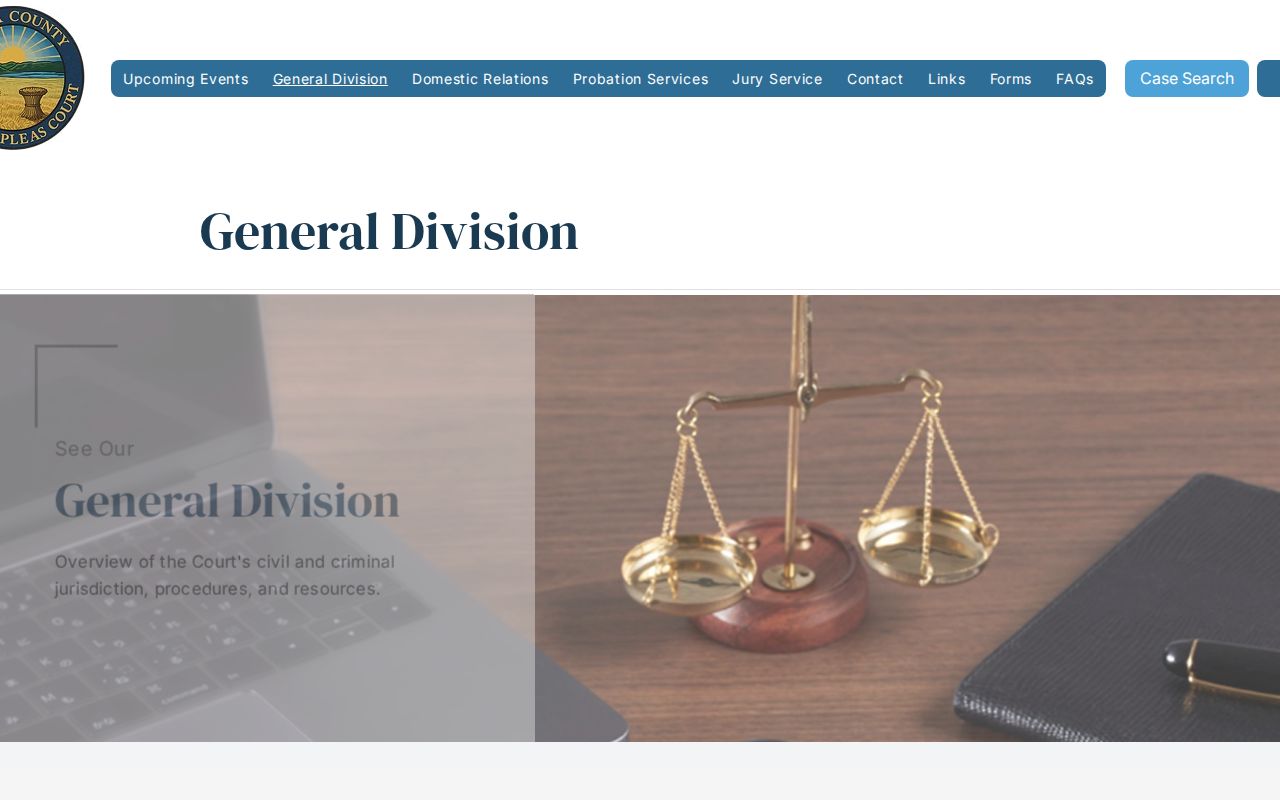
Settle the division structure first. Then read docket entries or request copies from the right court.
What a Criminal Docket Shows
Local rules shape what a pending General Division case must show. The court keeps both a computer record and an appearance docket. Rule 1.15 covers the appearance docket. It must identify the assigned judge and the nature or purpose of each filing. The rule also marks entry types. A case-ending judgment, a final entry, and a dismissal entry each read differently. Rule 1.17 adds scheduling and outcome dates to the computer record. Read together, these records tell more. A Gallia County criminal docket is far more than a list of hearing dates.
| Case number | The court identifier for the General Division case. The research does not establish a public format to be guessed. |
|---|---|
| Assigned judge | The judicial officer identified on the Common Pleas appearance docket. |
| Filing purpose | The nature or purpose of documents and entries placed in the case record. |
| Scheduling record | Pretrial, trial-assignment, mailed-notice, and continuance details required for a pending General Division case. |
| Closing entry | A designation such as judgment, final entry, or dismissal entry, plus the final-entry date required in the computer record. |
The Common Pleas local rules spell out those fields. CaseLook's public landing page does not display its detail layout. Don't assume screen fields or attachments from that page alone.
Gallia Criminal Docket Vocabulary
Local vocabulary separates an event from its outcome. An arraignment addresses charges and a plea. A disposition is the resolution itself. The final entry is the formal case-ending label in the Common Pleas record. These terms often sit near each other on the docket, but they mark different things and different dates.
- Appearance docket
- Gallia Common Pleas' running record that identifies the assigned judge and the purpose or nature of filings.
- Preliminary hearing
- A Gallipolis Municipal Court proceeding in a felony matter before grand-jury consideration.
- Disposition date
- The later Common Pleas setting used after a felony guilty plea for final disposition before the assigned judge.
Track a Gallia County criminal docket by its newest entry. An older hearing notice may yield to a continuance or later order. A court clerk can confirm the current setting but cannot advise which legal step to take.
Stages on a Criminal Docket
Gallia County criminal cases follow no single script. Common Pleas Rule 3.03 sets arraignment timing. Arraignment may occur at a preliminary hearing, on indictment, or soon after arrest. The rule also sets a disposition date before the assigned judge after a felony guilty plea. A misdemeanor plea may be disposed of immediately. Those rules describe how the docket reads, not how fast any case moves.
Docket flow: Charge or preliminary record › Arraignment › Pretrial settings › Plea or trial › Disposition › Final entry.
A municipal preliminary record in Gallia County can be followed by a General Division felony record. Read the court line on every entry. It tells you whether the case still sits in municipal court or has moved to Common Pleas.
Gallia Felony Dockets Across Courts
Gallipolis Municipal Court handles felony preliminary hearings before grand-jury consideration. Its published bond terms also state a transfer rule. Felony bond money moves with the case to Common Pleas rather than coming back. That is why the trail often splits. Someone may trace an early municipal criminal docket and then need a separate Common Pleas docket for the later felony stages. The move between courts routes the case; it proves no result. Gallipolis Municipal Court's bond-information page explains the bond options. It also covers the transfer rule for Gallia County criminal docket cases.
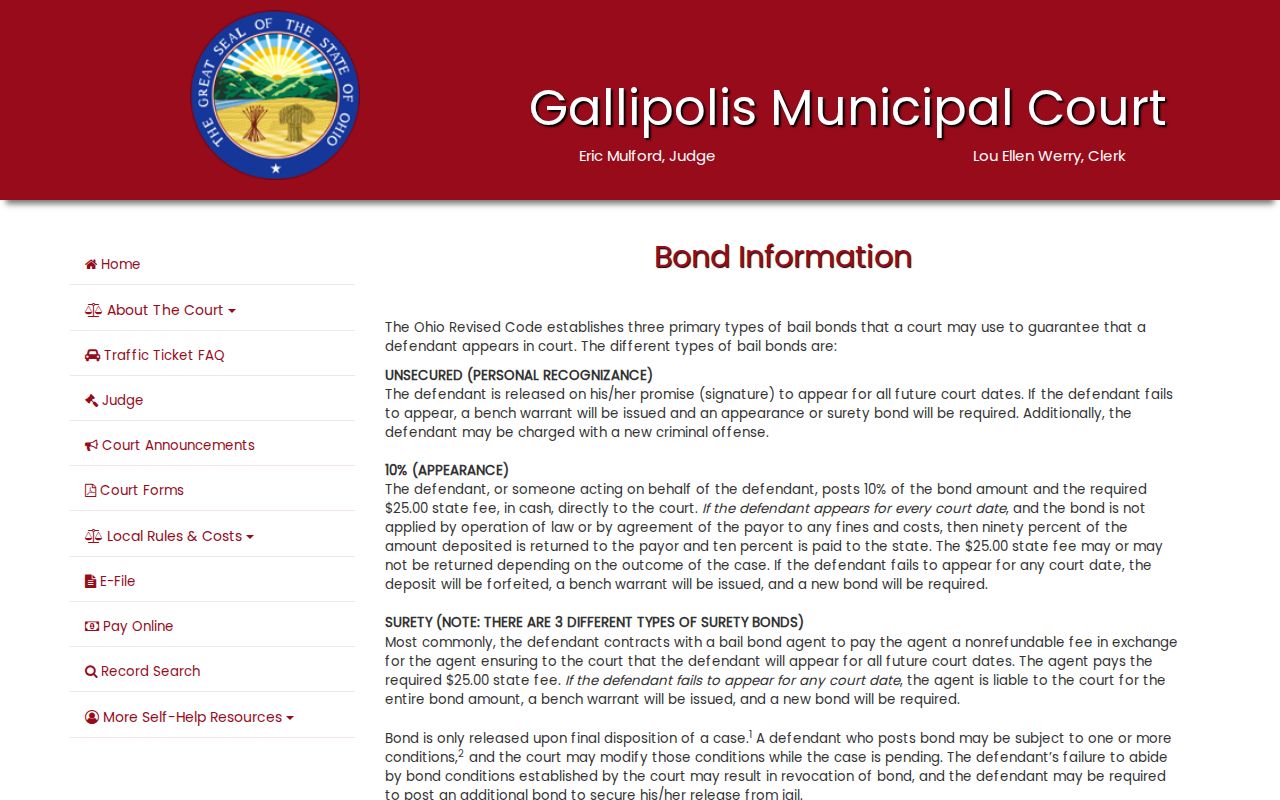
The municipal court lists personal-recognizance, 10-percent appearance, and surety bond options. None of them signals a final criminal disposition.
Which Court Holds Criminal Dockets
Court level decides where a Gallia County criminal docket lives. Felonies belong to the General Division of the Gallia County Court of Common Pleas. Gallipolis Municipal Court, meanwhile, covers the whole county. Its docket includes misdemeanors, traffic matters, and felony preliminary hearings. So its reach goes well past one city's docket. Not sure which court has your case? Check the court named on any notice you received. That name is the best starting point, especially when the case is new or the path is unclear.
| Court | Criminal docket scope | First record contact |
|---|---|---|
| Gallia County Court of Common Pleas General Division | Felony criminal cases after the Common Pleas case begins. | Gallia County Clerk of Courts Legal Division and eAccess. |
| Gallipolis Municipal Court | Misdemeanors, traffic matters, and felony preliminary hearings. | Municipal Clerk and CaseLook. |
| Probate/Juvenile Court office | Separate juvenile files, which are not ordinary public criminal dockets. | The Probate/Juvenile office under its access rules. |
The Gallipolis Municipal Court jurisdiction page spells out the municipal role in criminal cases. Juvenile files sit under separate local confidentiality rules. So a Common Pleas or Municipal docket search never adds up to a full juvenile-record search.
Gallia Criminal Docket Clerk Access
Common Pleas Local Rule 1.13 opens a direct door. It applies when the online criminal docket leaves a question unanswered. The Legal Division Clerk lets you look at an original document or case file. Viewing happens during normal business hours. The file stays in the office, though. Copies come for the applicable photocopy fee. The clerk aims to respond within about 24 hours.
Make your Gallia County criminal docket request easy to fill. Give the case number and name the document or entry you need. Say whether you want a plain or certified copy. State how you would like it delivered. The Legal Division posts phone, fax, and email contacts, but it offers no general criminal-record request form and no guaranteed electronic-copy method. Ask the clerk how to send your specific request. The office does not publish its per-page or certification price, so confirm the photocopy fee before you count on a total.
Gallia Criminal Docket Update Delay
A missing CaseLook update does not mean a case went away. The court's Record Search notice is blunt about this. Computer record information can lag a filing or judicial action by at least 24 hours or longer. It may change without notice. It is not the source for verified information. That warning matters for a Gallia County criminal docket. It applies whenever an appearance, bond action, or continuance has just happened. The paper trail at the courthouse is usually ahead of the screen.
Want a verified municipal answer? CaseLook tells you to send a request to the court. Another option is visiting during regular business hours. Gallipolis Municipal Court lists its general number as (740) 446-9400. Need a Common Pleas record? Go to the Gallia County Clerk of Courts Legal Division instead. That office sits at 18 Locust St., Gallipolis, Ohio 45631, and answers the phone at (740) 446-4612. Hours run Monday through Friday, 8 a.m. to 4 p.m.
Note: Check the newest court entry. It, not an absent online update, is the better source for a current criminal setting or result.
Gallia Criminal Docket Appeal Route
An appeal from a Gallia County Common Pleas criminal case does not stay in one record. It becomes its own Fourth District Court of Appeals docket. The trial court's appearance docket and the appellate docket relate to each other. But they are not one record. They may carry different case numbers and different entries. The Gallia County Clerk of Courts Legal Division serves both the Common Pleas Court and the Fourth Appellate District Court, so the clerk can help you tell whether a document belongs in the trial file or the appeal.
The Supreme Court of Ohio trial-court directory confirms the Gallia court structure. Treat a local eAccess result as partial, not as the complete appellate record.
Gallia Probation and Criminal Dockets
Gallia County Common Pleas posts a Probation Services page. It includes online check-in and self-report information, transfer material, a treatment-provider list, and forms. These services can cross paths with a criminal docket after a court action. Still, the published material has limits. It does not show that every service is open to every person, that a separate specialty docket is searchable, or that any eligibility rule is met. For public docket status, the underlying court case remains the place to look.
The official Common Pleas Probation Services page holds the details. It is the page behind this Gallia County criminal docket information.
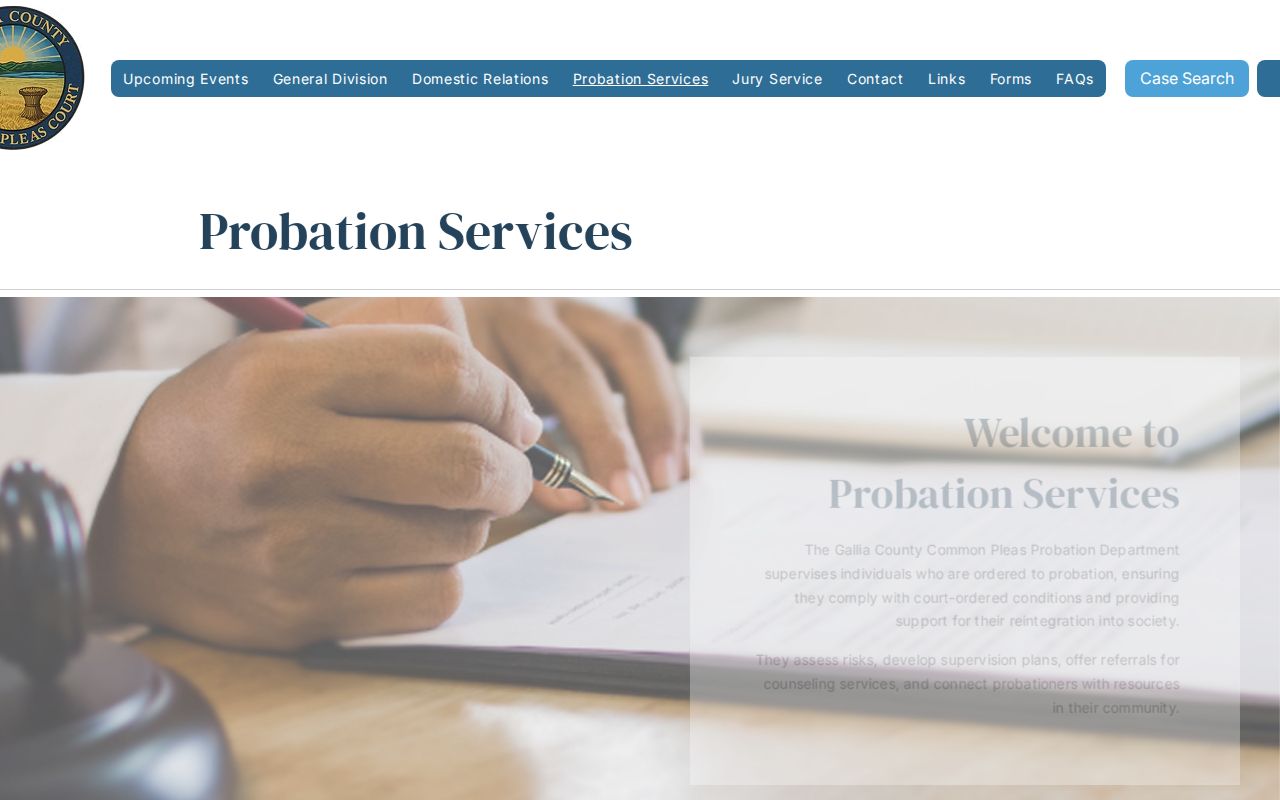
Contact Probation Services or the court for current program procedures. A docket entry alone will not tell you program status.
Gallia Criminal Docket Research Limits
The public routes show where to start. They do not put every data field or every historical record online. Gallianet eAccess exposes no durable inventory of search fields. CaseLook shows its entry notice up front. Its live search fields appear only after the disclaimer process. Those fields were not reproduced from an identifying case. A missing result can reflect the court, timing, a restriction, or plain online-coverage gaps rather than the absence of a criminal case.
Use neutral case identifiers for a narrow clerk inquiry. Do not lean on a reproduced result, a warrant list, or a broad name collection in place of the court-held criminal docket.
Public Access and Sealed Criminal Dockets
Ohio court records are presumptively public under the Rules of Superintendence. Public access does not mean every record is online or unrestricted. Common Pleas Local Rule 1.13 allows inspection of an original document or file kept by the Clerk. Inspection happens during regular business hours. Nothing leaves the office. Copies require the applicable photocopy fee, which the local rule does not price. Municipal printed-copy practices and Common Pleas copy practices are not interchangeable.
Ohio Revised Code 2953.32 governs adult sealing. It is the official statute behind this Gallia County criminal docket material.
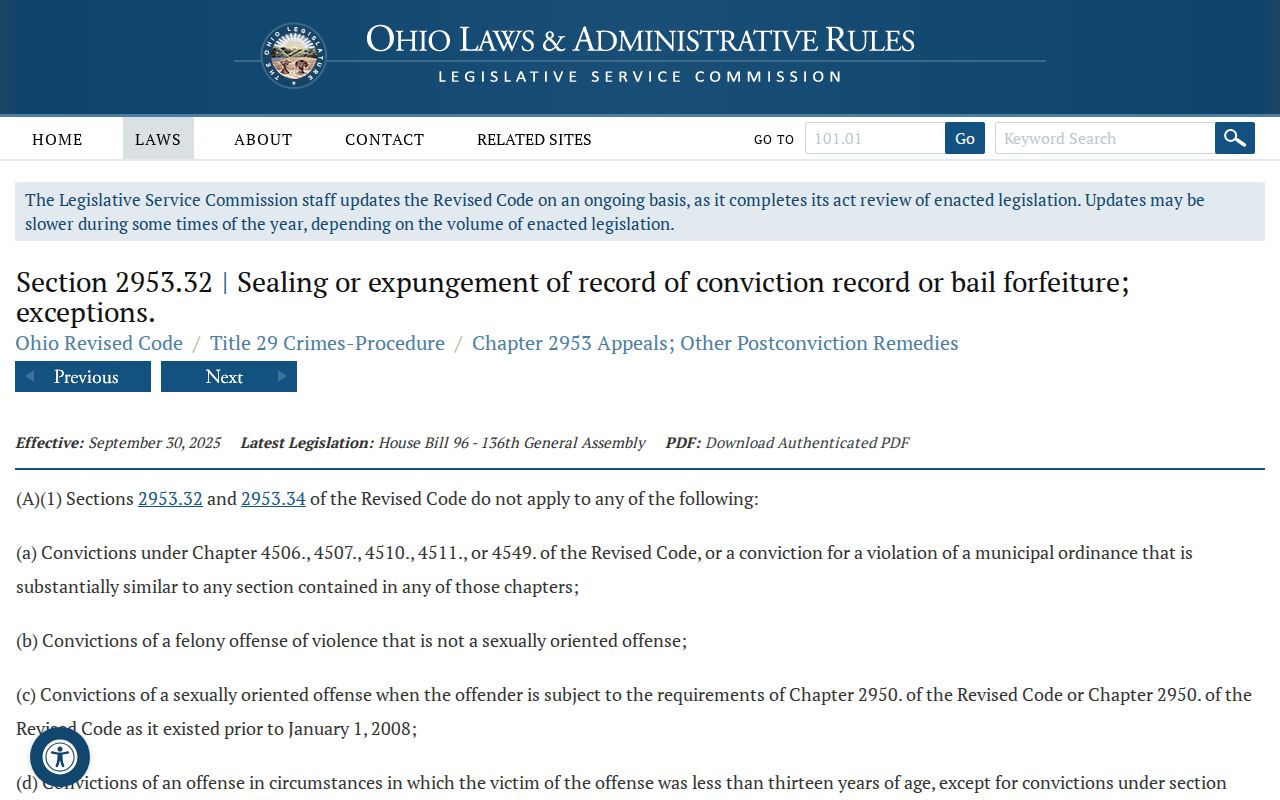
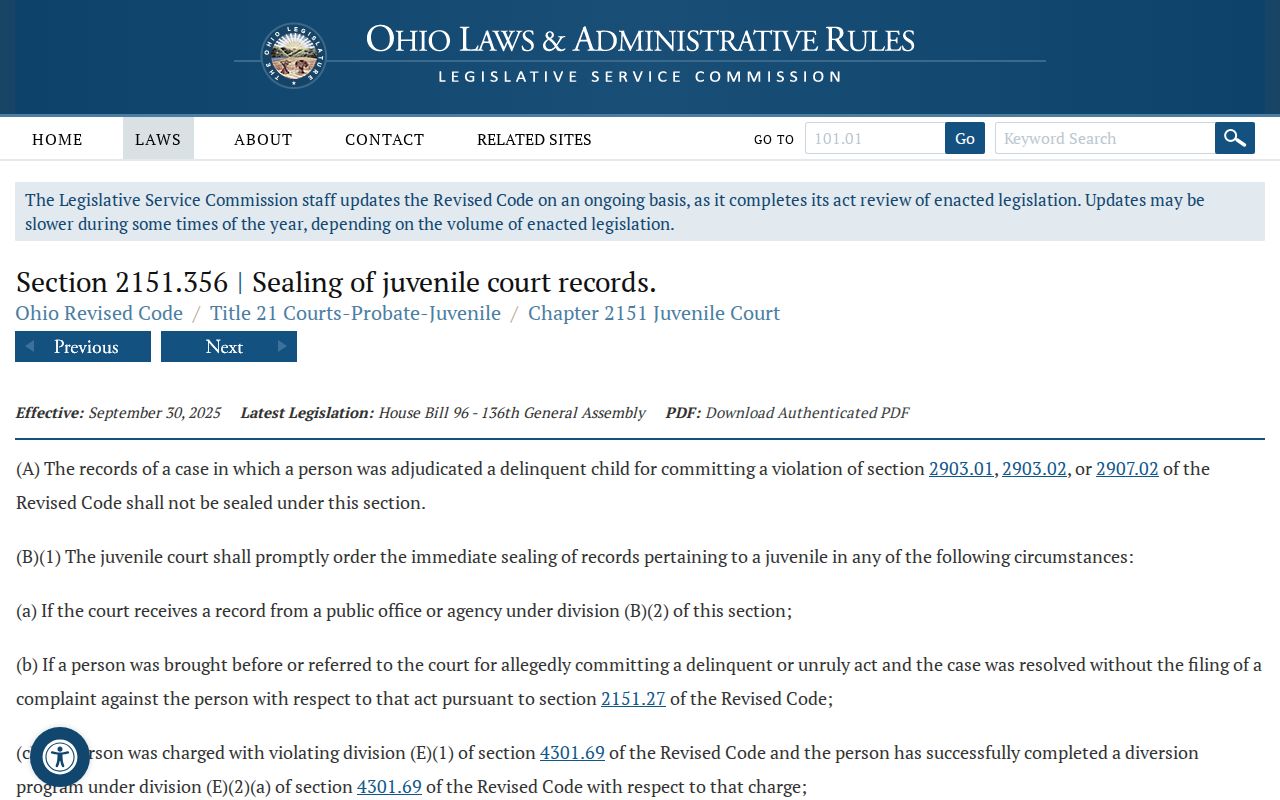
Sealing in Gallia County works differently for adults and juveniles. Adult convictions and bail forfeitures fall under a separate statute. That statute carries its own list of exclusions. Just because a case shows up in a docket search does not mean the person qualifies. The result itself never reveals whether a court has granted sealing. For juvenile records, Ohio Revised Code 2151.356 governs, and that official code section spells out how juvenile sealing works for this Gallia County criminal docket topic.
Gallia County's local juvenile rule keeps juvenile cases confidential. The public cannot inspect them without the judge's permission. That access restriction is distinct from the question of sealing an adult criminal docket.
Key Rules:
Ohio Rules of Superintendence 44 through 47 establish the court-record access framework and the presumption of access.
R.C. 2953.32 governs the adult sealing application framework for the conviction and bail-forfeiture records it covers.
R.C. 2151.356 is a separate juvenile sealing framework, alongside Gallia's local rule that treats juvenile files as confidential.